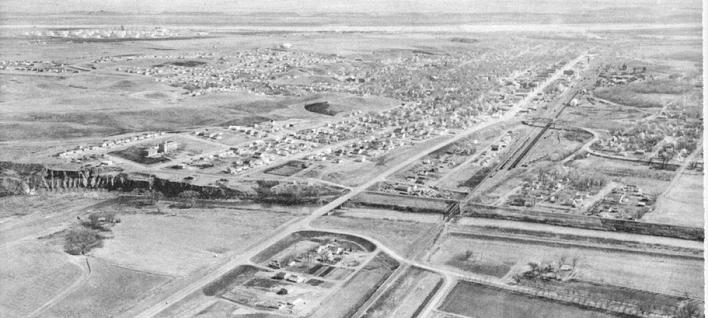
Mandan has experience three (3) major growth spurts in its almost 150 year history. The first in the late 1870s resulted from the Northern Pacific Railroad expanding its system with construction of a bridge across the Missouri River and tracks onward west to Montana. The second was in the early 1920s with the completion of the first automobile bridge on the river between St. Louis and Seattle. Population surged in 1950s in response to the announcement of the establishment of a 28,000 barrel per day petroleum refinery by the Standard Oil Company.
1951
The Army Corps of Engineers completed a study proposing 100-MW hydro-electric power based near their former Rock Haven snagboat port northeast of Mandan. The site closed to river service and reclaimed by the federal government in the mid 1930s after the automobile bridge, completed in 1922, allowed truck traffic to pair with rail-based freight transportation to make river transporation obsolete in the upper Missouri River.
The dam, projected to be similar to the future Big Bend Reservoir in South Dakota, suffered from controversy surrounding land use impacts, public-verses-government power-generation ratios and water-use rights with linked to the Garrison Dam project soon to begin construction. The costs verses positive impacts were not enough to get the project approved.
Source: Big Dam Era; Missouri River Division Army Corps of Engineers
1952
1953 Heskett Stn Water Intake Construction
On May 15, Montana Dakota Utilities (MDU) announced plans to construct the R. M. Heskett Power Station as a lignite-fired steam-generating plant north of Mandan. The company, which had been looking at the site since 1932, purchased 125 acres on the south half of the historic James Bellows homestead from the Zachmeier family. The estimated contruction cost was $9 million ($110 million 2025$) for 25 MWH of production.
The plant, named after a former executive for MDU, began operation in 1954. By 1964, it had already been expanded to 60 MWH of capacity.
NOTE: Newspaper articles mistakenly reported the site as previously owned by Elijah Boley. The site home to the steamboat port "Bellows Landing." The facility was renamed "Rock Haven" after the US Army Corps of Engineers purchased the site as its river snagboat support facility.
1955
1955 Aerial View to the ENE (Click to Enlarge)
1958
1959
The city was approaching its peak as a commerical center, unaware of the future impacts of the interstate highway under construction at the time north of the city.
Mandan boasted five elevators, with a combined capacity of over 760,000 bushels. Occident Elevator had two facilities, one located in the "Syndicate" area and the second along Main Street. The other grain storage and handling businesses included Slope Grain and Feed Company; the Farmers Union Grain Association and the Mandan Farmers Co-Op Elevator.
On January 30, firefighters battled a six hour long fire in sub-freezing weather to extinguish one of the largest fires in Mandan's history. The Hulette Building, home to the city's Ben Franklin 5-and-dime store, was a complete loss. Damage was estimated at $200,000 ($1.7 million 2015$). Fortunately, no loss of life or significant injuries occurred due to the event.
Much of the information presented on this page is based on the research conducted by Diane Boit on assignment to the Mandan News in her weekly "Those were the Days" columns.
The MHSoc's museum and office is located at 3827 30th Avenue NW; Mandan, ND 58554 Contact us at info@mandanhistory.org